
Transport of a 250-ton crane between Chile and Colombia
There are projects that, from the very first briefing, already suggest a certain level of complexity. Not only because of their size, but because of everything they involve: coordination, timing, and critical decisions in the field. This case fits that description perfectly.
A Project Cargo Success Story
In the world of Project Cargo, there are no “standard” operations. Every movement requires rethinking the approach: how to handle the cargo, how to transport it, how to minimize risks at every stage, and above all, how to anticipate challenges before they arise.
The transport of a 250-ton crane from Chile to Colombia is a good example. Not because of the uniqueness of the equipment itself, but because of the combination of factors involved: volume, fragmentation, operational environment, and specialized ocean freight logistics.
A Tailor-Made Project from the Start
A technical inspection was carried out at origin to gain a detailed understanding of the cargo. This is far more than a formality; it is where the critical points of the project are truly identified:
- Component geometry
- Individual weights
- Lifting requirements
- Risks associated with dismantling
The crane was divided into 29 pieces. A standard approach was simply not feasible. The dismantling process had to be adapted to the equipment’s specific characteristics, something that often makes the difference between a smooth operation and a chain of incidents.
Once dismantled, the cargo was transported from Antofagasta to an authorized storage facility. There, several tasks were carried out that often go unnoticed but are essential: high-pressure cleaning, conditioning, and preparation for ocean transport. Everything was focused on preventing future issues, both operational and documentary.
At the same time, and although less visible, export documentation was managed. Coordination with authorities, regulatory compliance, and certificate control were all part of the process. In Project Cargo operations, an administrative error can bring the entire supply chain to a halt.
Ocean Freight: Decisions That Shape the Entire Project
The shipment departed from the Port of Angamos. At first glance, this might appear to be a conventional operation. It was not.
For this shipment, a vessel operating under a part-cargo arrangement was selected and chartered specifically for the project. This decision was significant. Choosing between a regular liner service, a full charter, or an intermediate solution has a direct impact on:
- Operational flexibility
- Transit times
- Adaptability to oversized cargo
In this case, the chartering team had a clear objective: to ensure optimal conditions for heavy-lift components without compromising safety or delivery schedules.
The ocean voyage lasted approximately 15 days. Throughout that period, monitoring was not passive. Continuous operational oversight was maintained, which is essential whenever the margin for reaction at destination is limited.
The Critical Stage: Discharge in Urabá
If there is one point where planning is truly put to the test, it is at destination.
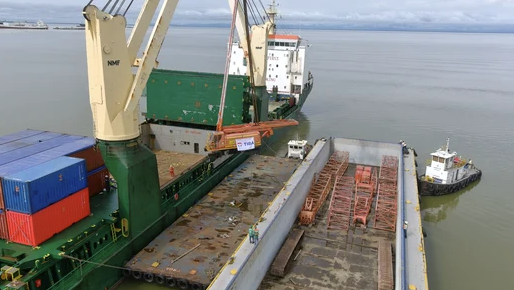
The discharge operation took place in open waters off the coast of Urabá, Antioquia. There was no conventional port infrastructure available. As a result, the operation required positioning a hopper barge alongside the vessel.
These types of maneuvers demand:
- Precise positioning
- Coordination between maritime and cargo handling teams
- Strict safety protocols
There is no room for improvisation.
The discharge was completed in approximately seven hours, without incident. Achieving a result like that is never a matter of luck; it is a direct reflection of thorough planning and real-time coordination.
What Lies Behind It: Real Expertise, Not Just Theory
This type of project highlights a simple reality: specialization in Project Cargo is not based solely on technical capabilities, but on accumulated experience in complex operational environments.
Managing oversized cargo requires constant decision-making:
- Which transport solution to use
- How to break down the cargo
- Which risks are acceptable and which are not
- How to coordinate stakeholders across multiple countries
And above all, understanding that every phase directly influences the next.
Practical Recommendations for Companies Facing Similar Projects
Based on this case, several valuable lessons can be drawn:
- Invest time in the initial planning stage. A thorough technical inspection can save significant costs and avoid future complications.
- Do not underestimate documentation requirements. In complex international operations, documentation is often one of the main bottlenecks.
- Carefully evaluate the ocean freight solution. The cheapest option is not always the most efficient one from a supply chain perspective.
- Prioritize destination coordination, especially when standard infrastructure is unavailable.
- Demand proactive monitoring throughout the entire transit. Continuous visibility reduces risks and improves response capability.
Because in Project Cargo, everything ultimately comes down to one thing: anticipating challenges better than anyone else.


Leave a Reply
Want to join the discussion?Feel free to contribute!