
EU–Mercosur Agreement 2026: when it enters into force and what changes for businesses
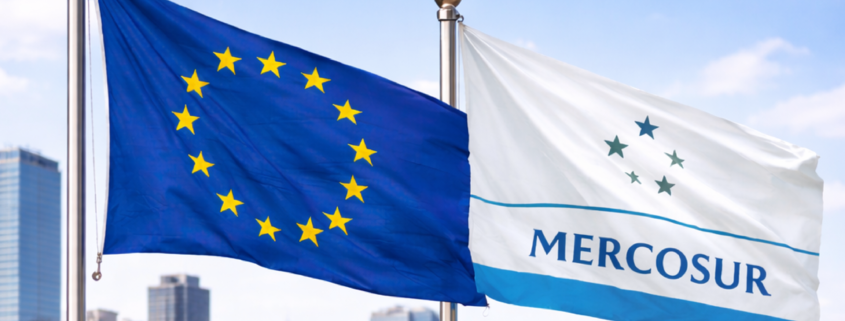
The EU–Mercosur agreement can open a new stage for many international operations: greater predictability, fewer barriers and new opportunities between both blocs.
The European Union has taken a key step to activate the provisional application of the EU–Mercosur Interim Trade Agreement. Once the required procedures have been completed, this new trade framework will begin to apply on May 1, 2026, bringing forward part of the agreement’s effects before its definitive entry into force.
For importers, exporters and logistics operators, this is not just an institutional development. The agreement may have a direct impact on costs, commercial planning, customs strategy and market access between the European Union and the Mercosur countries.
When does the EU–Mercosur agreement enter into force?
The date for the provisional application of the EU–Mercosur agreement is May 1, 2026. This initial phase refers to the interim trade agreement and will allow part of the trade content to begin to be applied while the full processing of the association agreement continues.
What does it mean that the EU–Mercosur agreement is applied provisionally?
It means that companies will be able to start benefiting from certain trade measures without waiting for full ratification of the overall agreement. In other words, part of the practical impact may begin earlier, albeit within the limits and conditions set out in the agreement itself.
This may translate into:
- Early activation of certain trade advantages.
- A more predictable framework for trade and investment.
- Greater visibility to plan operations between both blocs.
What is the EU–Mercosur interim agreement?
The EU–Mercosur Interim Trade Agreement is the instrument that brings forward the strictly commercial part of the agreement between the European Union and Mercosur. According to the European Commission, it coexists with the EU–Mercosur Association Agreement, which also covers political and cooperation pillars; once the latter fully enters into force, it will replace the interim agreement.
Which countries are part of the EU–Mercosur agreement?
This framework affects the European Union and the four Mercosur countries:
- Argentina.
- Brazil.
- Paraguay.
- Uruguay.
What changes does the EU–Mercosur agreement bring for importers and exporters?
The main development is that provisional application will allow the elimination or reduction of tariffs on certain products, in accordance with the schedules and conditions set out in the agreement, as well as creating more predictable rules for trade and investment.
For companies, this may mean a more stable environment in which to operate and make decisions with less uncertainty, provided that the applicable requirements for each operation are met.
Key changes of the EU–Mercosur agreement in business operations
Beyond the headline, the agreement may influence several key areas of international activity.
Among the most relevant effects are:
- Reduction of trade barriers in certain operations.
- Greater predictability for imports, exports and investment.
- Improved market access conditions.
- Greater legal certainty for planning commercial relationships in the medium and long term.
Benefits of the EU–Mercosur agreement for companies
For many companies, what matters will not only be when it starts, but how it can improve their operations. The agreement may become an opportunity to review costs, analyze markets and strengthen commercial positioning in South America or Europe, depending on each flow and product.
What advantages can the EU–Mercosur agreement offer?
Among the potential benefits for companies are:
- Possible cost reductions in certain international operations.
- Improved competitiveness compared to other markets.
- Greater stability for planning purchases, sales and investments.
- New business opportunities between the EU and Mercosur.
- A clearer framework for developing long-term relationships.
Which sectors may be affected by the EU–Mercosur agreement?
The specific impact will depend on each product, its tariff treatment, the existence of quotas and the applicable requirements, especially regarding origin and regulatory compliance.
Even so, the agreement may be particularly relevant for sectors with a direct link to international trade or with transatlantic supply chains. The EU Council also highlights its relevance for areas such as agriculture, automotive, chemicals, pharmaceuticals, services and investment.
Sectors with the greatest interest in the EU–Mercosur agreement
Among the areas that may follow it most closely are:
- Automotive.
- Chemical industry.
- Pharmaceuticals.
- Agri-food.
- Raw materials.
- International trade.
- Logistics.
Will there be safeguards in the EU–Mercosur agreement?
Yes. The provisional application of the agreement does not imply uncontrolled market opening. The framework includes safeguard mechanisms to respond if certain imports cause or threaten to cause harm to European producers, with reinforced monitoring of sensitive products.
What does this mean for companies?
It means that the agreement aims to combine trade openness with protection for the most exposed sectors. For companies, this adds an important element: the new scenario may open opportunities, but it will continue to operate within a regulated framework and with control mechanisms.
What should importers and exporters review now?
Given the provisional application of the EU–Mercosur agreement, it is advisable not to focus only on the news. The truly useful step is to analyze the impact on each specific operation and prepare the company in advance.
Keys to preparing for the EU–Mercosur agreement
Before May 2026, it is advisable to review:
- Which products may benefit from the agreement.
- What the actual tariff impact of each operation may be.
- Which origin requirements must be met and certified to access preferences.
- Whether documentation and internal processes should be adapted.
- What business opportunities may arise in the Mercosur market.
Why is the EU–Mercosur agreement important for international logistics?
Because it can directly influence operational planning. A clearer and more stable trade environment facilitates decision-making, reduces uncertainty and allows flows to be reorganized with a more strategic vision, in line with the EU’s goal of strengthening more resilient supply chains.
Impact of the EU–Mercosur agreement on logistics operations
From a logistics and customs perspective, the agreement may affect issues such as:
- Cost structure.
- Customs strategy.
- Route and flow planning.
- Access to new markets.
- Commercial and sourcing decision-making.
EU–Mercosur Agreement 2026: a new stage for companies
The provisional application of the EU–Mercosur agreement marks a significant change in the trade relationship between both blocs. For companies, the key will not only be knowing the date, but understanding how it affects their operations, what opportunities it can generate and what adjustments should be made to effectively take advantage of the new trade framework from the outset.


Leave a Reply
Want to join the discussion?Feel free to contribute!