
Situation in the Strait of Hormuz: Impact on global air and ocean freight
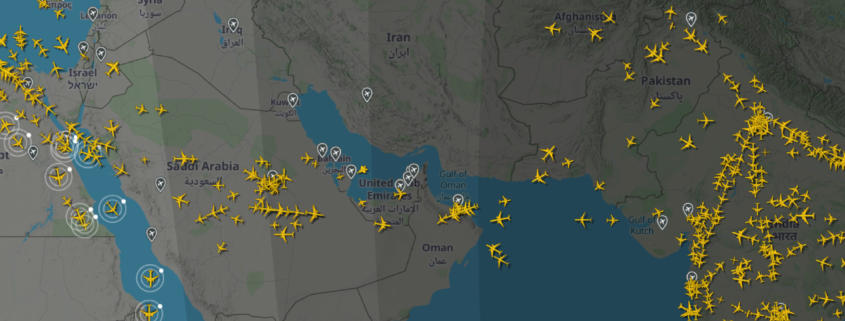
Following the recent developments in the Strait of Hormuz, we have prepared a guide outlining the key questions and answers regarding its impact on the global supply chain and the operational alternatives available.
1. What is currently happening in the Strait of Hormuz?
The situation has escalated following U.S.–Israel strikes on Iran, prompting the Islamic Revolutionary Guard Corps (IRGC) to issue VHF warnings stating that “no vessel is permitted to transit the Strait of Hormuz.”
Although the strait has not been officially declared closed, most commercial vessels and oil tankers have suspended transits due to security risks.
Major container shipping lines have halted transits and diverted vessels, with more than 170 ships positioned in or around the strait.
2. How does this impact ocean freight operations?
Shipping lines have paused all sailings through the Strait of Hormuz until further notice due to security concerns.
This includes the suspension of port calls at key Gulf ports such as Jebel Ali, Khor Fakkan, Fujairah, Doha and Asaluyeh, resulting in multi-day delays, diversions and congestion at alternative anchorage points.
3. How does this impact air freight operations?
Several Middle Eastern airspaces are closed or heavily restricted, leading airlines to suspend, reroute or cancel flights.
Dubai International Airport, Abu Dhabi International Airport and Doha International Airport have suspended all commercial operations, eliminating regional air cargo capacity and forcing carriers to operate via alternative airports where possible.
Rerouting is generating significant airfreight saturation and congestion, extending overall flight times.
4. What alternatives do we offer to support customers in ocean freight?
We provide:
- Alternative routings avoiding the Strait of Hormuz, supported by our global carrier network.
- Rebooking and priority follow-up on diverted vessels for affected shipments.
- Real-time visibility of any container inside or near the strait through continuous monitoring of carrier advisories.
- Scenario planning for customers importing from or exporting to the Gulf (UAE, Qatar, Bahrain, Kuwait, Saudi Arabia, Oman).
- Cost impact assessments, considering increased war-risk premiums and bunker surcharges applied by carriers.
5. What alternatives do we currently offer for air freight?
We support our customers with:
- Rerouting through open and secure air corridors outside restricted Middle Eastern airspaces.
- Space optimization on alternative routes, taking into account global capacity constraints and rate volatility.
- Time-critical shipment solutions through multimodal combinations (air + ocean + road), where viable.
- Continuous monitoring of suspensions, diversions, war-risk surcharges and fuel-related cost increases.
6. Are there alternatives for cargo currently en route to the Gulf region?
Yes, depending on cargo location and carrier restrictions. Options include:
- Diversion to nearby secure ports for temporary storage or re-routing.
- Transshipment via alternative hubs outside the Gulf (e.g., East Africa, India or the Mediterranean).
However, there are currently no viable ocean alternatives for direct access to Gulf ports, according to multiple carrier advisories.
7. Are delays and cost increases expected?
Delays and rate increases are likely due to:
- Significant delays caused by vessel rerouting or holding patterns.
- Airline rerouting via northern corridors (Turkey–Central Asia) or southern corridors (Oman–Pakistan–Central Asia), increasing flight times by 2–4 hours.
- Higher ocean and air freight rates driven by capacity shortages, extended routes and war-risk premiums.
- Potential fuel surcharge increases due to oil market volatility.
8. What is our recommendation for customers?
- Provide volume forecasts to proactively secure space.
- Review safety stock strategies in anticipation of potential supply chain lengthening.
- Plan for cost variability across both air and ocean modes.
Maintain close communication with us for shipment-specific updates, as the situation is evolving rapidly.
9. Is it safe to ship through the region once traffic resumes?
Current guidance from the International Maritime Organization (IMO) urges maximum caution and recommends avoiding the region unless strictly necessary until conditions improve.
At TIBA, we will only approve routings that comply with international safety authorizations and carrier-endorsed security protocols.
10. How frequently will we update customers?
We will provide continuous real-time updates, aligned with:
- Carrier advisories.
- Regional government notices.
- Airline network status.
- Port and airspace closure alerts.
We will continue to provide updates as further developments arise.


Leave a Reply
Want to join the discussion?Feel free to contribute!