
Project Cargo Transportation of a 13-Ton Industrial Press Between Colombia and Peru
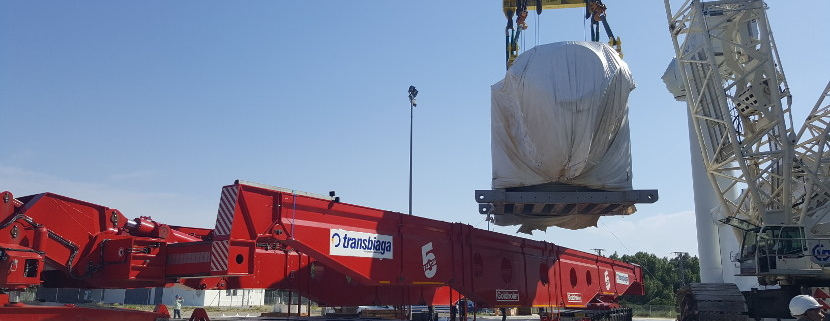
When Transportation Is the Visible Part, but the Risk Lies Elsewhere
Moving a 13-ton industrial machine sounds like “heavy cargo.” And yes, it is. But weight was not what defined this project.
What truly makes the difference in operations like these is something else: ensuring the press reaches its destination without compromising project continuity. No moisture where it should not be. No impact damage that went unnoticed at the port. No poorly executed handling maneuver that later turns into plant downtime. That is where projects are won or lost.
The assignment involved transporting a 13-ton industrial press from Bogotá (Colombia) to Callao (Peru). This was not a simple point-to-point shipment. It was an operation involving multiple stages, changing environments, and teams working across two countries. On top of that, there was a clear technical requirement: electrical components sensitive to moisture.
When you combine oversized cargo, critical handling requirements, and technical sensitivity, you are no longer managing a shipment. You are managing a logistics project.
The Real Objective: Delivering the Machine Ready for Operation
In industrial environments, a logistics issue rarely remains just “a delay.” It usually affects production, customer commitments, and generates costs that appear later: labor hours, rescheduling, inspections, repairs, or even disassembly.
That is why the focus was not simply on transporting the press, but on ensuring optimal delivery conditions for commissioning and start-up.
The challenges were clear from the outset:
- Moisture Protection and Technical Preservation
The electrical components required continuous protection throughout road transportation, port terminal handling, and the ocean voyage. Proper packaging alone was not enough; preservation was essential. - Road Transportation with Specialized Equipment Requirements
The Bogotá-Buenaventura route required equipment adapted to both the weight and dimensions of the cargo, as well as carefully controlled execution due to operational restrictions. - Handling Operations with Structural Risk
Loading, transfer, and stowage are three critical moments when machinery can sustain damage that is not immediately apparent. For industrial equipment, even minor movement during transit can become a major issue during unloading. - Operational Changes and Adaptability
In Project Cargo operations, variables are inevitable: port windows, crane availability, route adjustments, and waiting times. The operation needed flexibility without affecting delivery deadlines. - True International Coordination, Not Just “Email Communication”
With teams in Colombia and Peru, communication had to be continuous. Not because of procedure, but because a lack of visibility is often the root cause of operational issues.
End-to-End Strategy: Controlling Every Phase, Not Just the Movement
The solution was to treat the entire supply chain as a single integrated operation.
- Specialized Protection from Origin
Before transportation began, a heat-sealed protective system was applied to isolate the machinery from moisture. This distinction matters: it was not simply about covering the machine, but about creating a genuine barrier against environmental changes.
The machine would be exposed to multiple conditions throughout its journey: highways, humid environments, port storage areas, and sea air. Every stage mattered. - Logistics Engineering and Operational Planning
A preliminary assessment was conducted to define the route, restrictions, permits, critical points, and resources required for handling operations. It sounds obvious, but with oversized cargo, the obvious is often where failures occur.
In fact, planning was not just a document. It was the mechanism used to anticipate risks and avoid improvisation at critical moments. - Low-Bed Road Transportation
The press was transported from Bogotá to Buenaventura on a low-bed trailer, with operational monitoring throughout the journey to maintain schedule control and ensure safety. - Supervision of Handling Operations and Port Activities
Origin-side handling operations were supervised to ensure procedures were executed according to plan. In projects like these, poorly positioned cargo or inadequate securing cannot easily be corrected later. The consequences are costly. - Flat Rack Container Shipment
Due to its dimensions, the cargo was shipped on a Flat Rack container, a common solution for oversized freight that cannot fit inside a standard container. The critical factor was stowage and securing, both of which were essential to prevent movement during the ocean voyage. - Continuous Monitoring Through to Destination
End-to-end visibility was maintained throughout the operation, not as a formality but as a genuine control tool. This enabled coordination among all stakeholders involved, including origin, transit, and destination teams, and most importantly, allowed rapid response when required.
In logistics, what appears to be a minor adjustment today can become a significant delay tomorrow if not managed properly.
The Result: Project Continuity and an Incident-Free Delivery
The operation was executed according to plan, with no significant deviations. The machinery arrived in optimal condition and, most importantly, without impacting the associated industrial project. Ultimately, that was the real objective.
Key Outcomes
- Achievement of the established deadlines, despite the complexity of the shipment.
- Effective protection of cargo with specific technical requirements. In this case, proper stowage made all the difference.
- Operational control maintained throughout every stage of transportation, with full visibility preserved.
- Seamless coordination between teams in Colombia and Peru, something that is not always straightforward in multimodal operations.
- Safe handling at every transfer point, with particular attention paid to intermediate operations, where issues most commonly arise.
- Risk mitigation through a comprehensive end-to-end logistics solution. It is not just about covering individual stages, but understanding how they connect and affect one another.
In reality, the value lay not only in moving cargo from point A to point B. It lay in coordinating everything that could potentially affect the project. And, frankly, that includes almost everything: timing, handling, communication, and anticipation. That is where the real difference is made.
It is worth taking a moment to recognize the team that made this operation possible. Special thanks to Johana Rivera, Emma Rocio Castro Hurtado, and Natalia Martínez Hernández, together with the teams in Colombia and Peru, whose operational expertise and ability to anticipate challenges were key to ensuring the project was executed as planned.
Because in projects like these, success does not depend solely on good planning. Above all, it depends on people who understand where risks may emerge and take action before they do.
What to Review Before Moving Oversized Cargo
If you manage high-value industrial equipment and work with tight deadlines, there are three essential questions worth asking before launching the operation:
Where Is the Real Risk?
It is not always on the road. Sometimes it lies in port dwell times, cargo transfers, or permits that are assumed to be “quick” to obtain.
Does the Cargo Require Preservation or Just Packaging?
Moisture, vibration, temperature, and environmental exposure all influence the strategy. And when it comes to electrical machinery, moisture is far from a minor detail.
Who Has Visibility Across the Entire Supply Chain?
When multiple stakeholders are involved, risk increases at transition points. Without continuous monitoring and visibility, operations become fragmented and control gaps begin to appear.
Risk Management: What Ultimately Determines Success
In international industrial projects, success rarely depends on simply transporting cargo. It depends on how risks are identified, managed, and controlled throughout the entire process.
In this case, the combination of planning, specialized protection, international coordination, and operational control enabled the successful transportation of a 13-ton industrial press between Colombia and Peru while preserving cargo integrity and meeting the project’s objectives.


Leave a Reply
Want to join the discussion?Feel free to contribute!